← CloudScale Plugin Help/CloudScale Backup & Restore, Free WordPress Backup Plugin with One-Click Restore & Cloud Sync
Dropbox
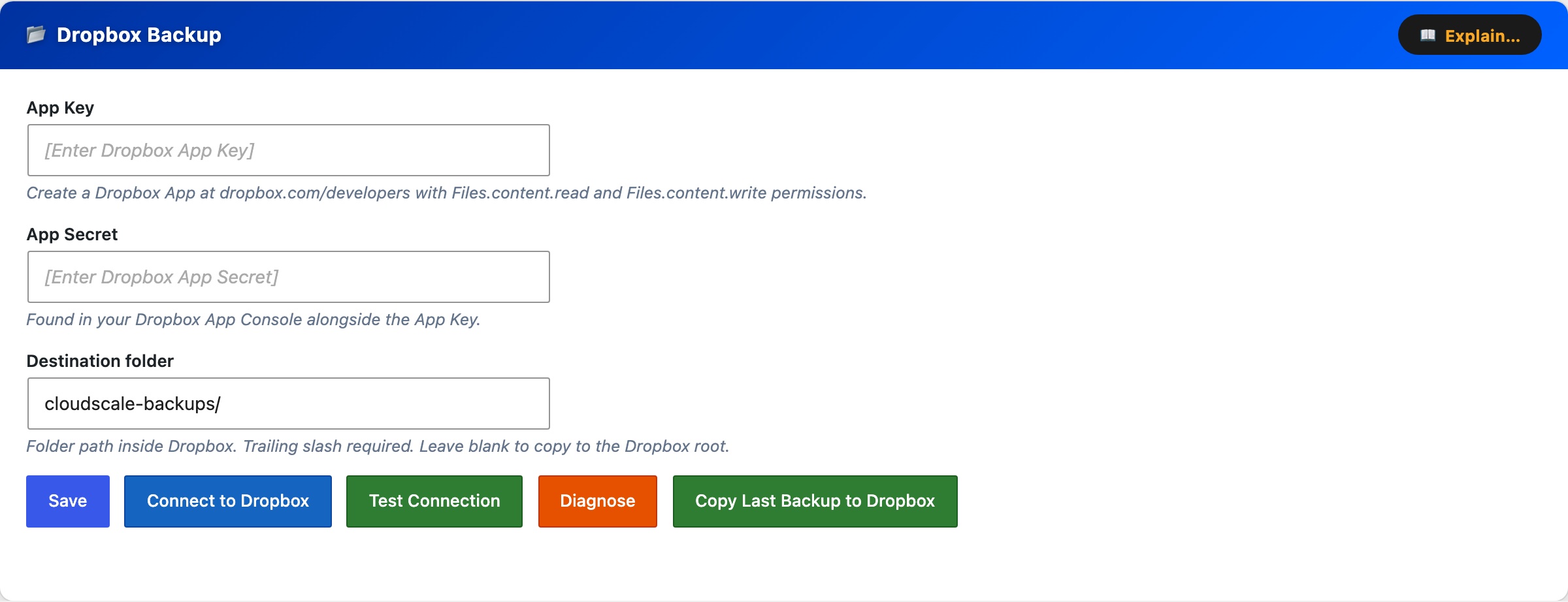
The Dropbox Backup card uses rclone to copy backup zips to Dropbox after every local backup. If you already set up rclone for Google Drive, skip straight to Step 3, you just need to add a new remote.
rclone remote name, the name you gave the remote during rclone config, e.g. dropbox.
Destination folder, path inside Dropbox where backups are copied. Trailing slash required (e.g. cloudscale-backups/). Leave blank for the Dropbox root.
Test Connection, verifies rclone can reach Dropbox with the configured remote.
Diagnose, shows rclone version, remote name, and troubleshooting tips.
Copy Last Backup to Cloud, immediately copies the most recent local backup zip to Dropbox, outside of any schedule. Does not create a new backup, it copies whatever zip is already on the server. Before starting, the plugin checks how much free space Dropbox has:
- If Dropbox has enough space, the sync starts immediately.
- If Dropbox is running low, an inline warning appears showing MB free vs MB needed, with two options: Delete oldest (removes the oldest non-golden backup from Dropbox to make room, then starts the sync) or Sync anyway (proceeds regardless).
When configured, the card shows the destination path, number of backups in Dropbox, and time of last sync.
Dropbox Setup Guide
Step 1, Install rclone on the server (if not already installed)
curl -fsSL https://rclone.org/install.sh | sudo bash
Step 2, Fix apache home directory permissions
sudo mkdir -p /usr/share/httpd/.config/rclone
sudo chown -R apache:apache /usr/share/httpd/.config
sudo chmod 700 /usr/share/httpd/.config/rclone
sudo chown apache:apache /usr/share/httpd
sudo chmod 755 /usr/share/httpd
Step 3, Run the setup wizard as the apache user
sudo -u apache rclone config
Answer each prompt as follows:
| Prompt | Type |
|---|---|
e/n/d/r/c/s/q> | n (New remote) |
name> | dropbox |
Storage> | dropbox or the number for Dropbox |
client_id> | Enter (leave blank) |
client_secret> | Enter (leave blank) |
| Edit advanced config? | n |
| Use web browser / Use auto config? | n (no browser on server) |
config_token> | Paste token from laptop (see below) |
| Keep this “dropbox” remote? y/e/d> | y |
e/n/d/r/c/s/q> | q (Quit) |
For the highlighted config_token> step, run this on your laptop (install rclone first with brew install rclone if needed):
rclone authorize "dropbox"
A browser window opens, log in and authorise Dropbox. The browser shows “Success! All done. Please go back to rclone.” Rclone prints a long token like {"access_token":"..."}, copy the entire JSON and paste it at the config_token> prompt on the server.
Step 4, Save settings in the plugin
Enter dropbox in the rclone remote name field and your destination folder (e.g. cloudscale-backups/), click Save Dropbox Settings, then Test Connection.
Running out of Dropbox space
Dropbox Basic provides 2 GB free. Backup zips for a typical WordPress site are 200 MB, 2 GB, so you may fill Dropbox quickly unless you keep your retention count low or upgrade your Dropbox plan.
The plugin detects a Dropbox quota problem in two places:
- Before a manual backup, the cloud space pre-check warns you and offers a Free space on Dropbox button.
- Before a Copy Last Backup to Cloud sync, an inline warning appears on the card with Delete oldest and Sync anyway options.
The Delete oldest / Free space action removes the oldest non-golden backup from Dropbox one file at a time until the required space (plus a 15% buffer) is available. Golden images are never deleted. If all deletable backups have been removed and there is still not enough space, you will need to free up Dropbox quota manually, upgrade your plan, or switch to a higher-quota provider such as Google Drive or S3.
Note: when a Dropbox account is over quota, Dropbox returns an extremely large number as the “free space” field. The plugin works around this by computing free space as total quota − used quota to detect the over-quota state reliably.